Convicted spy Rod Ramsay as a potential Gardner heist suspect (Part 1)
Convicted spy Rod Ramsay as a potential Gardner heist suspect (Part 2)
Convicted spy Rod Ramsay as a potential Gardner heist suspect (Part 3)
Convicted spy Rod Ramsay as a potential Gardner heist suspect (Part 4)
Convicted spy Rod Ramsay as a potential Gardner heist suspect (Part 5)
Full Report Downloadable pdf version
Convicted spy Rod Ramsay as a potential Gardner heist suspect
(Part One)
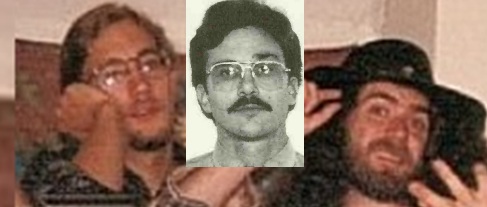
Unidentified man (left) with Gardner Museum security guard and heist suspect Rick Abath (right)
Rod Ramsay mugshot from June 7, 1990 (center)
Though his name has never been raised with the public as a Gardner heist suspect by either investigators or the news media, Roderick James Ramsay, a former Boston resident, arrested on espionage charges in Tampa, FL, on June 7, 1990, just ten weeks after the robbery, is certainly someone who remains worthy of consideration. Ramsay was convicted of espionage two years after his 1990 arrest and spent over a decade in prison after his conviction in 1992.
The Boston Globe, New York Times and other news media long ago abandoned hard reporting on the Gardner heist case in favor of “conjecture based on a
theory,” mutely disseminated by government officials
and their surrogates, like former FBI Gardner heist lead investigator Geoff Kelly, who in retirement has updated his narrative
(changed his story). He now claims that the security guard Rick Abath was indeed in on the robbery, after publicly suggesting otherwise
on numerous occasions for over twenty years. Kelly, who has a book on the Gardner heist investigation coming out in 2026, bases his conclusion on information known to investigators the first week; that the Museum security system did not record anyone going into the Blue Room gallery,
where Manet’s Chez Tortoni was taken, with the exception Abath, who was recorded entering the gallery twice.
As Kelly himself said on CBS Good Morning ten years earlier, in 2015: "Someone went into the
Blue Room that night, and the only one that went in that room that night was the security guard [Rick Abath], according to the motion sensor printouts."
But when Abath refused to speak with CBS Good Morning, and said publicly he was not doing anymore interviews, the FBI and its surrogates reverted to their false narrative that Abath was tricked into letting the thieves in.
By April of the following year, in 2016, the Gardner Museum’s security director Anthony Amore, who is also
the FBI’s chief public relations surrogate on the case said:
“We have nothing to point at to say that he [Abath] was involved.”
An FBI podcast on the case starring Geoff Kelly in June of 2023 begins:
“In March 1990, art thieves conned
their way into the Isabella Stewart Gardner Museum.” Less than two years later, however,
Kelly told the Boston Globe he was convinced Abath was indeed involved.
But since Abath, who by his own admission was the person solely responsible for letting the thieves into the Museum, if he was indeed involved, which has always seemed
very likely, then the thieves did not con their way into the museum.
The stalemate ended a year after Rick Abath died, when Abath could no longer defend himself, but more importantly when Abath could no longer put the FBI's investigative team and its
coterie of surrogates into a position of having to defend themselves. Kelly, in retirement and in need of some juice for his book, now says he believes Abath was involved,
which everyone, not in one way or another riding the FBI's disinformation gravy train, or too timid to speak out, had been saying for over a dozen years, when Abath himself started
going public about his role as the guard who let the thieves in,
after being shielded from public scrutiny for over 20 years.
Meanwhile, real facts, which would lead to the kind of real answers the public is surely entitled to after close to four decades, remain unreported.
Among those facts are the evidence supporting the possible involvement of Ramsay, along with the Gardner security guard Rick Abath, and others, such as Brian McDevitt.
McDevitt lived just three miles from the museum, and had been convicted in an attempt to rob the Hyde Collection, an art museum in Glens Falls, NY, of a Rembrandt and other works ten years earlier.
In a Sixty Minutes interview, McDevitt said that he had no alibi for the robbery and a girlfriend of his at that time, Stephanie Rabinowitz said that McDevitt had asked her to lie, to say he was with her that night. In addition, McDevitt told Rabinowitz he was involved in the heist, she now says.
In addition to being interviewed on Sixty Minutes about his possible role in the Gardner heist, McDevitt was brought before a grand jury in 1993, regarding the robbery.
But in Netflix, This Is A Robbery Tom Mashberg said: “Very remarkable that between 1990 and 1997 there were very few stories about the crime. There was never, say, an arrest or a suspect being questioned. Bobby Donati, nobody ever had a chance to ask him any questions obviously.”
“Obviously”? Donati did not die until 18 months after the Gardner heist and was under FBI surveillance during at least some of that time, as he made collections from bookies and loan sharks for
the mob affiliated Vinnie Ferrara gang. Kurkjian too, in the same Episode 3 of
This Is A Robbery falsely stated that: “Between 1990 when the theft took place and around 1997 there was nothing.”
In Kurkjian's own book, he devotes six pages to a ransom note and a follow up note, the Museum received in 1994, which he said may have been
"the biggest disappointment, and the
closest [Gardner Museum Director Anne] Hawley feels the museum has yet come to recovering
the stolen art."
The Gardner heist occurred in 1990, but nothing happened that fits
the current state sponsored narrative until 1997 so everything before that time, and much after it, is memory-holed, by the likes of Mashberg and Kurkjian.
Real facts have gone unreported, or papered over with false facts by an iniquitous guild of access-driven journalists and
news media gatekeepers, who instead disseminate false narratives and suspect theories, originating from within the investigation itself.
These corrupted, crowd saucing manipulators exploit
the intrinsic sensationalism of the robbery, while investigators release information "in dribs and drabs," as WATD radio's Christine James observed,
in their efforts to
maintain narrative control of a fairy tale.
If ordinary hoodlums had actually pulled off the Gardner heist, we would know their names by now, or
the Gardner heist would have been long forgotten. But there is little opportunity for outsiders to fill in the blanks when the facts are so capably filled
by high budget productions, and journalists who traffic in deceit.
But while Rod Ramsay was a criminal, and a more experienced one than any of the individuals whose names have been tossed around by the news media as the actual perpetrators,
he was not an ordinary criminal. He was a soon to be incarcerated spy.
Another example is the highly promoted, highly reported on, reviewed and taken seriously Gardner heist productions was Last Seen Podcast
by the Boston Globe and a local NPR affiliate, WBUR, with Kelly
Horan serving in the role as senior producer. But while it was treated as a serious work of journalism, it was not, as Horan herself admitted three years later.
This arch-disseminator of Gardner heist myth, falsely claims on her Boston Globe bio page
that Last Seen Podcast "was named a top 10 podcast of 2018 by The Atlantic, the Financial Times, Stitcher, and other outlets.”
None of that is true, although it did garner quite a lot of attention, with dozens of local journalists endorsing it on social media at the time of its release
in September of 2018.
In 2021 and again in 2025 the same New York Times writer put it on a list of preferred podcasts.
One called "6 Podcasts About Making and Appreciating Art," and the other was "7 Podcasts About the Art of the Scam."
Last Seen Podcast (about a robbery) fits neither category, of the New York Times stories, but such is the clickbait power of the keywords [Gardner heist] that articles referencing Last Seen Podcast
and its Gardner heist subject matter, are
page-view powerhouses, real winners, though definitely not a winner for podcast listeners, looking for accurate information.
Last Seen Podcast does not even fit the category of “true crime,” as Horan herself acknowledged in an interview two years later:
"As someone who also has enjoyed a fair amount of pot boilers I knew that red herrings would work and
so my goal in structuring the entire [Last Seen Podcast] ten episode series,
the kind of narrative arc that I wanted to put in place was one where each episode would take you in deep inside a theory, you would meet the central characters of that theory and then you would leave that episode saying 'Aha! that's the one.' only to have the next episode come along and make you doubt that because that was my experience, the experience of reporting this was like whiplash. You know, 'This must be it.' 'No this must be it.' 'He must have done it. No he must have done it.'" —Kelly Horan
Horan’s “narrative arc,” however, was sold to the public as a serious work of investigative journalism.
“Iris Adler, Executive Director for Programming, Podcasts and Special Projects at WBUR said that ‘the producers of Last Seen have obtained unprecedented
access to case files, first-ever interviews and this podcast is the result of a year of investigative reporting to unravel the crime’s many mysteries.’”
It seems the Boston Globe and WBUR were given unprecedented access to case files, just so they could present an assortment of junk theories, “red herrings,” in the words of
the person who headed up the project, to present the public with disinfotainment. Last Seen podcast did not “unravel” any of “the crime’s many mysteries.”
A short time before its release one of the staff members on the project, Eve Zuckoff, now a city reporter for WBUR, tweeted out: "If you've spoken to me any time in the last 15 months, THIS is the secret @WBUR
and @BostonGlobe podcast I've been working on! Please SUBSCRIBE and get ready for SO. MUCH. MORE."
If WBUR and the Boston Globe were serious about unraveling mysteries they would not have made Last Seen Podcast in secret.
In 2016, Last Seen consulting producer Stephen
Kurkjian wrote that "secrets
that could lead to the whereabouts of the artwork remain hidden among associates, family members and friends of the thieves, and it's these
individuals who must be convinced to break their traditional code of silence." But the following year when Last Seen Podcast began production, there was no
outreach through the mass media capabilities of WBUR and the Boston Globe. It seems inviting public participation was viewed more as an obstacle more than opportunity.
The public is just one more
scapegoat to explain away the pretend-failure of the FBI's pretend investigation.
Two years later, when the Netflix 4-part series, This Is A Robbery, was in the planning stages,
Kurkjian met with the Barnicle Brothers, who were heading up the production of Gardner heist series which was first released on Netflix in 2021.
Kurkjian's "major advice to them," he said, "was not to try to solve it, that if they tried to solve it, it would be too frustrating for them.
I told them I had tried since 1997 and I still know nothing about who did it, why they did it and most importantly, where the paintings had been stashed.”
Once again the "deep dive" was kept secret from the public until shortly before the release date, and limited to the same
to the same cast of journalistic characters, who either claim to know nothing, or speak in the vaguest of terms about what the FBI believes, or lie about what "the FBI said."
Shelley Murphy: "The FBI believes the stolen artwork ended up in the hands of Guarente, a convicted bank robber with ties to the Mafia in Boston and Philadelphia who died in 2004."
Kevin Cullen: "The FBI believes the stolen artwork ended up in the hands of Guarente, a convicted bank robber with ties to the Mafia in Boston and Philadelphia who died in 2004."
Stephen Kurkjian: "The FBI believes that the heist was pulled off by local thugs who had been made aware of the museum’s poor security by fellow gang members.
Or they just lie. Tom Mashberg:
"In 2015 "the F.B.I. named two long-dead, Boston-area criminals,
George Reissfelder and Lenny DiMuzio, as the likely bandits." The "likely" bandits? In 2013, the FBI said they knew who the thieves were.
Geoff Kelly said "We know who did it." In 2015 Mashberg reported: "Mr. [FBI's Geoff] Kelly showed me that Mr. Reissfelder and Mr. DiMuzio closely
resembled police sketches of the two men who had entered the museum." A month later in an email response to an inquiry by BostInno,
FBI spokesperson Kristen Setera said: “the FBI has NOT publicly identified the suspects involved in the Gardner heist.”
Mashberg's "Stealing Rembrandts" co-author, Anthony Amore, specifically stated in March of 2015 that "nobody named anybody."
In Episode 4 of Last Seen Podcast, called “Two Bad Men,” Boston Globe reporter Shelley Murphy, one of the leading disseminators
of Gardner heist disinformation for over 30 years, acknowledged that: “All these theories are frustrating. For everything that points toward these particular
suspects,” she lamented, “there’s something that points away.”
Frustrating indeed when a journalist spends decades of their career sourcing stories about the Gardner heist from people inside the investigation, who persist in casting
aspersions on “suspects” for whom “there’s something that points away,” something exculpatory, something that excludes them from having been the actual Gardner heist robbers, effectively deflecting attention from other actual suspects like Ramsay, Abath, and McDevitt, despite strong evidence, and for whom there is little, if anything, “that points away."
It has not been so frustrating, however, that Murphy and The Boston Globe have ever done anything except continue to assist in this state-sponsored disinformation operation,
anything except except cooperate fully with it, by disseminating the FBI’s dubious, ever-changing narrative, supported by false facts, while profitably propping it up with
sensationalist news stories, a ten-part podcast, and a four-part Netflix series.
As full of inaccuracies and outright deceit as the Globe’s Last Seen Podcast, and The Boston Globe’s Gardner heist news stories generally,
is their four-part Netflix series This Is A Robbery This Gardner heist crockumenatary
was produced and directed by Colin Barnicle and his brother Nick, sons of the former Boston Globe columnist Mike "Blarneycle" Barnacle.
When Reader's Digest was set to reprint a 1995 Mike Barnacle Boston Globe column he wrote about a friendship between two young cancer victims, but was unable to substantiate the story.
"Blarneycle" was eventually compelled to resign from the Boston Globe in 1998.
Barnicle’s sons have done numerous projects for the Boston Red Sox, which is owned by the same people as The Boston Globe, John and Linda Henry.
Colin Barnicle was an intern for the Red Sox front office when he was a teenager in 2005. Linda Henry, The Boston Globe’s chief executive officer” was also an
executive producer
of the Netflix Gardner heist documentary. The Barnacle Brothers continue to prosper through their relationship with the Henry’s,
This year they were awarded a Sports Emmy for Outstanding Documentary Series in 2025, for their Netflix production about the 2004 Boston Red Sox.
In addition, four past and current Boston Globe reporters appear prominently in the series: Stephen Kurkjian,
Shelley Murphy, Kevin Cullen,
and Tom Mashberg. All four of these
reporters at the time of the documentary had been reporting about the Gardner heist for at least a quarter century.
In addition, all four of the journalists, who appear in the documentary, aside from archival footage, were current or former Boston Globe reporters.
This Is A Robbery was released in 2021. At that point Murphy and Cullen had both worked at The Boston Globe for over thirty years. Kurkjian reported for the Globe for
over fifty years. He retired in 2007, but stayed on as a freelancer, covering the Gardner heist for the Globe for another 14 years, until 2021.
Although it had been a while, Mashberg recently wrote a freelance assignment for the Globe in October 2025, on the Louvre jewels heist,
and was employed by The Boston Globe as their
New York Bureau chief and then as a reporter for about three years in total, in the early nineties.
Along with Boston 25’s Bob Ward, these three Globe reporters (Mashberg, Kurkjian and Murphy) account for over ninety percent of the original reporting
on the Gardner heist the past ten years, a good deal of it insincere, false and misleading. Cullen covered the case for the Boston Globe in the days following the robbery, but has written little on the case in the last decade.
In 2015, Cullen expressed a good deal of skepticism about the Gardner heist investigation writing:
“On Thursday, federal authorities released a surveillance video showing a security guard letting a man into the Gardner Museum the night before it was robbed of 13 priceless paintings in 1990.
US Attorney Carmen Ortiz said officials hoped someone in the public might recognize the mystery man.”
“How could this crucial piece of evidence just be coming out, 25 years after the city’s most infamous unsolved crime? It seemed like either a breathtaking bit of incompetence by the FBI, or more evidence of the bureau’s reluctance to share information with law enforcement partners and the public.”
But by the time of Netflix's This Is A Robbery, Cullen had been won over. Since that 2015 column about the heist investigation,
Cullen had undergone his own Mike "Blarneycle" Barnicle type troubles.
After WEEI had questioned the truth of some of his past work, The Boston Globe conducted two reviews of Cullen’s past work, and while the veteran columnist was
given a three month suspension, he managed to keep his job.
The Boston Globe issued a statement on their findings in June of 2018:
“The reviewers found Mr. Cullen’s writing to be ‘among the most appealing that appears in the Globe -- precise, well observed and often standing up for the forgotten man and woman with profound effect.’
However, the review did find some problems, concluding
that “his columns at times employed ‘journalistic tactics that unnecessarily raise questions about his accuracy’ that ‘may open the door to
providing seriously
misleading information to the public.”
In other words, Cullen employed the very kind of dark-arts, inside journalism, that has been a central and sustaining feature, a cornerstone of Gardner heist news coverage
in the Boston Globe's news reporting about the Gardner heist case, since at least 2013, as well as
in its podcast, Last Seen Podcast, and in its documentary about the Gardner heist, This Is A Robbery.
By 2021, Cullen loved Big Brother. He was happy to help promote the government’s dubious narrative about the Gardner heist on the Boston Globe’s Netflix series on the case,
using those same “tactics,” in the series, which had put Cullen in hot water back in 2018, as one of the Globe's Gang-of-Four journalist in the series.
Cullen’s statements in Netflix This Is A Robbery, like those of his fellow Globe affiliated journalists, Murphy, Kurkjian, and Mashberg,
included some that employed “journalistic tactics that unnecessarily raise questions about his accuracy” that “may open the door to providing seriously misleading information to the public.”
In fact if you haven’t got game, you’re not part of the highly compensated Gardner heist guild of journalists who have appeared over and over again in all of these productions, and
whose bylines appeared almost exclusively in Boston Globe articles about the case for decades.
In Episode 3 of This Is A Robbery Cullen says, "It's really important to understand how organized crime works in the city of Boston," as if the documentary,
or anyone ever, had done anything like establish
that the Gardner heist was pulled off by local members of organized crime.
But Cullen is in his wheelhouse now: "You had the Irish faction in Southie. You had another Irish faction in Charlestown bleeding [bleeding!] into Somerville," Cullen states,
laying on the Boston accent with a trowel, as if this Cullen guy isn't some dweeb from Malden, but of duh streets.
"In the North End you had this sort of coalescing force called La Cosa Nostra," Cullen continued long after one of Blarneycle's boys should have shouted "Annnd CUT!."
'This thing of ours.' The Mafia," Wow! We're really getting into
some deep dive shit but, again, nothing whatsoever to do with the stated subject of this documentary, the Gardner Museum heist.
"The sources for these Gardner heist news stories are almost exclusively Gardner Museum security director Anthony Amore, and FBI lead investigator Geoff Kelly.
Amore has been on the case for over twenty years, and Kelly who retired from the FBI 2024, is still out there speaking about the Gardner heist case, which he had worked as lead investigator for over two decades. Neither man can point to any tangible results of
any kind in the case."
The sources for these Gardner heist news stories are almost exclusively Gardner Museum security director Anthony Amore, and FBI lead investigator Geoff Kelly.
Amore has been on the case for over twenty years, and Kelly who retired from the FBI 2024, is still out there speaking about the Gardner heist case,
which he had worked as lead investigator for over two decades. Neither man can point to any tangible results of any kind in the case.
So not only have all of the reporters, who enjoy access to the Gardner heist investigators with the exception of Horan,
been working the case for decades, so too have the "investigators" they cover.
In February of 2026 interview podcaster Julia Cowley, a retired FBI agent and profiler said to Geoff Kelly:
"You get assigned this [Gardner heist] case and you had it the whole time up until you retired. Can you explain how unusual that is for someone to have the same case?
It's bizarre," Kelly said.
"I don't know of anybody that's had a case that's even close for that length of time," he continued.
"That case followed me through three squad changes and a move down to a resident agency down in Southeastern MA. The case stayed with me throughout."
The interviewer Cowley responded, "Usually when you transfer a squad the cases do not go with you if you transfer out of the office, and even go to another satellite office
the cases stay with that squad. So it is very unusual for a case agent to remain with a case agent throughout.
not only transfers from squads but different offices through their whole career.
Very unusual."
Kelly and Amore like to complain about unnamed armchair detectives, and their unspecified theories, about
and how much uncorroborated time and effort
these individuals create for the real investigators, like Kelly now retired, and Amore who is not a sworn law enforcement officer.
If Kelly's role was in his own words "bizarre," so too has been that of Amore.
The day after the heist, FBI (Boston) spokesman Paul F. Cavanaugh told the Boston Globe that
"The FBI does not generally rely on private
investigators when it is assisting in art-theft investigations.
However, agents will accept information from any source," he said.
"And when longtime Gardner Museum, hired IGI, a private investigative firm based in Washington DC
a private investigative firm based in Washington
begun by Terry Lenzner, who had cut his teeth as a lawyer for
the Senate Watergate Committee, the FBI’s
supervisors in Boston complained to US attorney Wayne Budd, who fired off a memo warning the museum that it
faced prosecution if it withheld information relevant to the
investigation," Kurkjian wrote in Master Thieves.
"Hatch responded, saying in his letter that he
was 'shocked and saddened' by Budd’s attempt to 'intimidate' the museum and that it cast 'a pall over future cooperative efforts.'"
But once Amore, who was primarily hired as security director of the Gardner, earned the trust of the FBI on the heist investigation side of
his role at the museum, he was invited onto the investigation team.
In 2012, Kelly arranged for Amore to have access to the case files,
and like Kelly, he has been "working" the case without success for decades.
"Convincing the FBI to share its responsibilities
on the case with the Boston police department and the Massachusetts state police was apparently an impossible proposition," Kurkjian wrote in Master Thieves.
Actual sworn police officers are shut out, while private investigators hired by the museum who have not been brought in by the feds,
invite threats of prosecution.
But Amore, who is also not a sworn law enforcement officer, received access to the case files, and nobody in the media challenges
Amore unprecedented, high profile role, which has been followed dozens of paid personal appearances, book deals, and two unsuccessful runs for two
different statewide offices, which his experience as the Gardner Museum security directly made him eminently qualified for,
as the Republican nominee
In 2025, the Boston Globe bought Boston Magazine, which was already an established channel of Gardner heist disinformation.
In 2024, the former editor, Carly Carioli, falsely reported in 2024
that on Sunday, March 17, [Myles] Connor will once again take center stage when he appears at the Regent Theater in Arlington, in conversation with Gardner Museum security
director Anthony Amore and Myles’s longtime manager and collaborator Al Dotoli, for the premiere of Rock n’ Roll Outlaw: The Ballad of Myles Connor, a new documentary that examines Myles’s incredible backstory—and what he may know about the Gardner heist.
But there was no documentary shown that day and there is still no documentary that has ever been released, about Myles Connor, his crimes, and his practically nonexistent musical career.
A year later though, there was a cheesy book about Connor, “The Rembrandt Heist: The Story of a Criminal Genius, a Stolen Masterpiece,
and an Enigmatic Friendship” by who? The Gardner Museum’s
security director, the Fed's friend, Anthony Amore.
Just how enigmatic the friendship between the Gardner Museum's head of security, Amore,
and Connor, whom Amore described in 2013 as a "charlatan" and a "huckster." (Time: 1:24:00)
is a question for the Gardner Museum’s trustees to decide.
What Amore finds interesting or special, an investigator forming a friendship with a criminal, is in fact all too common, and generally regarded
as an occupational hazard of investigative work,
as was seen with the relationship between two FBI agents John Connolly, and John Morris with Whitey Bulger.
In speaking of Myles, Amore said: "From the handshake we just hit it off. It was weird."
Was it though?
"We just have this appreciation, I think we both have this appreciation,” Amore explained, for art that I think is unique from the vast majority of people. (It's "unique" all right.) And somewhere in the middle between good and evil, you have that gray area where Myles and I meet."
That "gray area," right. That's what they all say, although generally it's through their defense attorneys.
In 2014 Amore said of Connor: "He is one of these guys who committed every type of crime you can imagine. Make a list. Brainstorm on crimes. He can check off every box. You name it. he's done it,
a real bad guy." But now in the title of his book, Amore
calls Connor a criminal genius. If Connor was such a criminal genius, we would never have heard of Myles Connor and he would not have spent most of his adult life in jail, in prison,
or on the lam.
Connor is the kind of criminal genius who does a long stretch in prison for selling art, burglarized from an elderly widow, to an undercover FBI agent, and then 15 years later does another long stretch in prison, for selling art stolen from the same elderly widow the same day, to a different undercover FBI agent. According to Connor's book, “The Art of the Heist,” the agent posed as an Italian mobster named "Tony Graziano," with a hankering for antique Simon Willard grandfather clocks.
Genius!
Ex-con Connor the con artist is a regular also on the Globe's Gardner heist podcast, and streaming docu-series circuit.
As Amore said, Connor is a huckster, so having Connor on to speak of things that
are either not corroborated, or flatly contradicted by the public record, is a natural fit for these faux-true true crime productions.
Connor helps reinforce the false narrative that Donati was involved in the Gardner heist, by claiming that Donati was one of the crew who burglarized
the Woolworth Estate in Monmouth, Maine with him. It was on the Saturday of Memorial Day weekend in 1974, he wrote in his memoir.
But Donati, was sentenced to 4-8 years in Walpole State prison in Middlesex Superior Court on May 22, 1974, only three days before the Woolworth Estate burglary. In Connor's book, he wrote that the burglary was on May 25th, which is consistent with newspaper accounts.
In his memoir, Connor wrote that he and Robert Donati "found ourselves strolling through the lush courtyard garden" at the Gardner Museum that summer [1975].
Connor claims he took this stroll while on the run from justice—having skipped trial for trying to sell stolen art to
an undercover FBI agent. Furthermore, this supposedly took place only a fews months after he claims he personally grabbed a Rembrandt off the wall
at Boston's Museum of Fine Arts, located barely a third of a mile away.
Despite Amore describing Connor as a high-profile "rock star" in Massachusetts, as well as someone whose high profile criminal background made him easily recognizable,
Connor expects the public to believe he sauntered through the museum undetected—and did so alongside Donati, who was at that time,
incarcerated at the Deer Island House of Correction.
Far from being a criminal genius, Connor fails to even sound like one in his own first person account of his fabricated exploits.
This go-along-to-get-along (quite comfortably one might add) news coverage of whatever questionable,
self-contradicting claims the Gardner heist investigators, and their minions, like Myles Connor, are promoting on any given heist anniversary,
or any other time, is just one of the many facets of the Gardner heist story, which point to there being more to this case than a simple robbery investigation,
something that might overlap with something like the strange case of convicted spy, and admitted bank robber Roderick James Ramsay.
Convicted spy Rod Ramsay as a potential Gardner heist suspect (Part Two)
|
By Kerry Joyce
