Gardner Museum Heist —Blog

Post-Truth Makes Camp in the Athens of America (Part One)
In 2024, in an article by Anthony Amore's Stealing Rembrandt's co-author, Tom Mashberg wrote that "it was reported in 2015 that the F.B.I. named two long-dead, Boston-area criminals, George Reissfelder and Lenny DiMuzio, as the likely bandits,"
Since Abath specifically stated and wrote that Reissfelder was NOT one of the bandits, then either Abath is covering up for Reissfelder and was himself involved, or Reissfelder was not involved. Abath covering up for Reissfelder only makes sense if Abath himself was involved. And if Abath was involved then the thieves did not con their way into the Museum, as Mashberg wrote. Seemingly there is so much territory to cover up, that they cannot come up with a historical account free of these kinds of glaring inconsistencies.A third possibility is that Abath was involved, but was truthfully insisting that Reissfelder was not of the two thieves for his own reasons. Maybe accusing an innocent man of a crime he himself had been a part of was a bridge too far for him. Or maybe he had a different story that he planned on telling. A year earlier in 2013, "Abath had "agreed to speak to the Globe to gain publicity for a book he was writing about the robbery," the Boston Globe reported at that time.
While he did upload some pages on social media concerning his life as a Gardner heist suspect, crime victim, whichever he was, there was nothing in them that related directly to the robbery itself in these writings. Although the big news at the time of the anniversary in 2023 was that the former Gardner security guard had recntly died after a long illness, nowhere to be found was erstwhile Gardner heist anniversary fixture, Stephen Kurkjian, author of the 2015 Gardner heist book, Master Thieves, who until 2023, had been popping up like Dick Clark on New Year's Eve, at every Gardner heist anniversary. Apparently nobody wanted to speak with Kurkjian, the reporter who had interviewed Abath but at least twice, the first time in 2005 and again in 2013. Kurkjian had had used some of the information he gleaned from those interviews in numerous newspaper articles, numerous pages of his book, as well as a podcast, and various documentaries, while solidifying his postiion as a leading authority on the case.Abath shared some of his story with Kurkjian, but only a small portion about what Abath knew about the case has come to light at this point.
For over 15 years Kurkjian had been unstinting in explaining away Abath's suspicious, and disconcerting actions on the night of the robbery as well as the night before the robbery, perhaps in hopes of getting another interview with Abath, and staying on the good side of an nvestigative team, which has also engaged in a campaign of disingenuoulsy minimized the possibility of Abath's role in the heist. Sounding more like Abath's lawyer than a journalist, Attorney Stephen Kurkjian told Emerson College Radio in 2016 that "Despite some reall questions marks as far as his negligence, his [Abath's]involvement has never ever been at all, his involvement with the bad guys, has never been proven." Still professionally active, though retired from the Boston Globe, Kurkjian was at a public event to discuss the case on November 16, 2023 at at the Westport [CT] Library. In addition he made an appearance at another event, a short time before the anniversary on March 7, 2024, hosted by Cohasset Elder Affairs in Cohasset, MA. This was the first public talk he had given since Abath's death. But there were no TV appearances, interviews with Kurkjian even a a quote from the person, the journalist, Stephen Kurjia, who was most closely associated with the travails of Rick Abath in his never satisfactorilly explained role in the Gardner heist. Or for that matter, from anyone else who knew the former Gardner security guard, except for his lawyer. Interestingly, Abath, who was from Delaware, had lived in Massachusetts for less than two years and hadn't lived in the state for over thirty years, arragned to have a Boston area attorney, George Gormley to announce his death to the news media and the public. Rest assured, even after Abath's death, Kurkjian is still promoting the official narrative, his and that of the Feds, about hapless Rick Abath's innocence, the certainty of which would go up and down like the tide, depending on what Abath was or wasn't doing about sharing information about the case with the media and on social media, during his life. His role should achieve some kind of stasis in the next few years, depending on what Abath left behind, what his family members decide to do and say, and what investigators have to say about him now that he is dead.Maybe Kurkjian will score that my-Rick-didn't-do-it interview, with Abath's widow. But for now, nobody wants any part of the Abath reporter, Stephen Kurkjian.
It is no surpise the investigation team in their role of serving up ever changing narratives about the Gardner heist, with the Boston Globe serving as head caterers, and the rest of the aggregating news media serving as the wait staff, that their latest follow the shiny object gimmick would have to be a real doozy to avoid any discussion of Rick Abath.
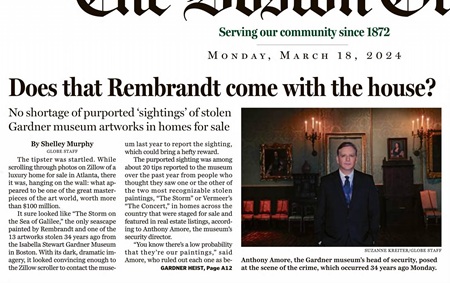
This year's Gardner heist investigation update did not disappoint in shallow deflecting gimmackry. "Twenty tips were reported to the museum over the past year from people who thought they saw one or the other of the two most recognizable stolen paintings, according to by Anthony Amore, which like all of Amore's claims was not corroborated in any way. "It sure looked like The Storm on the Sea of Galilee," to an anonymous Zillow scroller, the Boston Globe reported. And as Kelly Horan said in the Boston Globe/WBUR production "Last Seen Podcast," "Amore responds to every single tip. Even the patently cuckoo ones, 'cause you never know." Actually, much of what is disseminated in the public domain about the Gardner Heist robbery by dissembling disseminators like Horan and Amore is "patently cuckoo" to ensure that we will never know, what really happened. The Boston Globe should probably put out empty quarter-pounder-with-cheese boxes, wrapped in a grease resistant reproduction of this years 34th anniversary Boston Globe story, with that big picture of Amore that ran on the top of the Globe's front page, and then distribute them from drive-thru windows at McDonald's for free with every purchase. It won't help find the paintings, but it might help locate the Gardner Museum's security director, Anthony Amore. At least Amore might be the Gardner Museum's security director. It can sometimes be hard to know. Two long-time fixtures in the Boston news media suggested otherwise right before the anniversary this year. Carly Carioli, a past editor-in-chief of Boston Magazine reported in that publication on March 13, 2024 how "on Sunday, March 17, Myles Connor will once again take center stage when he appears at the Regent Theater in Arlington, in conversation with former Gardner Museum security director Anthony Amore. Two days later Boston Herald columnist and best-selling author Casey Sherman tweeted: "4 years after this podcast and zero accomplished by the so-called "Investigators" of the Gardner Museum Heist. The Director of Security has stepped down after nearly 20 years with nothing to show for it. Such an embarrassment." In this never ending help us find "our paintings," effort, it is hard to understand how such a misunderstanding could arise about Amore who is "constantly thinking about those paintings." Maybe because for several months until the anniversary, he had omitted his affiliation with the Gardner Museum in public spaces online, such as on his "X" page profile, where he regularly posts invective filled tweets, perhaps to goad fringe political actors, into targeting the Gardner Museum in some way, so he can have some face time with the media about something that does not involve lying about the Gardner heist. Maybe that, combined with the fact that some people might logically assume that since it is not really fitting or appropriate for someone, who is the head of security for the museum that bills itself as having been the victim of the largest art theft in the world, to appear on a stage, and in a documentary with a man, Myles Connor, whom Amore calls in repetitive, big-lie fashion, "the greatest art thief who ever lived."Considerint that Connor has has also misled investigators about having inside information about the Gardner heist, in times past, according to Amore himself, some might well conclude that therefore, Amore must have left his job at the Gardner Museum, to be making public appearances with this dissembling, cop shooting, art burglarizing, sleazebag.
But I guess when it comes to someone who is serving on the front lines of a cheesy, domestic disinformation warfare operation, like Amore is, you cannot depend on anything being quite as it appears. But it gets crazier. They want even more busy work: "With the majority of tips related to the two most famous paintings, officials say they’re trying to draw attention to some of the lesser known works, which might hold key clues to solving the crime." Even though, Special Agent Geoff Kelly, who heads up the Gardner heist investigation, for the FBI has said that "the people that took these paintings don't have them hidden in some private art gallery, sitting back and just reveling in their beauty. These paintings are most likely up in an attic somewhere, or in a basement, not being viewed by anyone." The odds of any stolen Gardner art coming back because of this kind of engagement with the public is infinitesimal. In 2016, when Juliette Kayyem asked Anthony Amore, "so what's the best recovery story given that you've studied decades-- or centuries of art heist-- what's your favorite recovery story where actually something was found, Amore replied with two examples, neither of which involved any investigators, or investigation locating stolen art. The examples he offered up were two instances where art was returned because the people who controlled it, decided to return it for their own reasons. These stolen Gardner Museum art "recovery" news stories are always seeded with some disinformation about who the perpetrators were, as in this most recent Globe story, which reports that "in 2013, Richard DesLauriers, then special agent in charge of the FBI’s Boston office, announced the bureau was confident it had identified the thieves — local criminals who have since died," a snippet of deceit, cut and pasted into a half dozen of these Gardner heist stories in the past seven years."In 2013, the FBI said:
“The FBI believes with a high degree of confidence that in the years after the theft, the art was transported to Connecticut and the Philadelphia region, and some of the art was taken to Philadelphia, where it was offered for sale by those responsible for the theft.” DesLauriers added, “With that same confidence, we have identified the thieves, who are members of a criminal organization with a base in the Mid-Atlantic states and New England.”
It was not until 2015 that the FBI announced that the thieves were "currently dead," and the Boston Globe did not even bother to pick up the story. If the thieves had died, like Reissfelder, DiMuzio, Donati, and all of the other red herrings they make insinuations about, then they couldn't have been offering it for sale in 2003. DesLauriers said the art was offered by those resonsible for the theft, another term for "the thieves."The only living person the Gardner heist disinformation players falsely cast aspersions on is David Turner, and since he is a suspect in three homicides, a crime for which there is no statute of limitations, he is hardly in a position to push back about it.
Nine years later, the "thieves are dead" is one of the most historically significant points, a big lie that bears repeating in every "recovery" story. Following the long established Gardner heist disinformation template, the story makes lavish use of the term local in their disinforming "buy local" campaign, while only making passing reference, to someone who was actually probably involved, Brian McDevitt, not even by name. He is just referred to as a "a Hollywood screenwriter." Yet there was no suspect more local at the time of the heist than McDevitt, who said on 60 Minutes, that he was at his home at the time of the Gardner heist, which was three miles away from the Gardner Museum, at 69 Hancock St. in Boston, and that he had no one who could give him an alibi. McDevitt had an extensive criminal background, which included trying to rob the Hyde Museum in Glen Falls, NY around Christmas in 1981. It was a failed caper that included knocking out a 26 years old female FedEx driver with ether, handcuffing her, and covering her eyes and mouth with duct tape in the back of her truck. Two months after the heist, the Boston Globe reported that: the FBI's investigation into the $200 million art heist at the Isabella Stewart Gardner Museum has targeted about a dozen suspects scattered across the world."Only after it became too late and the actual thieves, like McDevitt, had shed any local ties, did the official narrative became all about local thieves. Even in 1993, when he was brought before a grand jury to answer questions about the Gardner heist, a story written by Shelley Murphy, in the Boston Globe described McDevitt as "a Swampscott native who now lives in Los Angeles." Yes. But where was his legal residence when the Gardner heist occurred? He lived on Boston's Beacon Hill.
As was the case with Abath, the Feds wanted to minimize McDevitt's potential role in the Gardner heist. So even though Sixty Minutes broadcast the exterior of the building in Boston where McDevitt lived and McDevitt said, on national television, where he had spent the night alone when the Gardner Museum was being robbed, to Shelley Murphy McDevitt is "a Swampscott native," in the 1993 story and she has been lying about the Gardner heist ever since.
This publicity campaign is not an effort to generate interest in a Gardner heist recovery effort, it is an effort to redirect interest from the original crime under the guise of stolen art recovery. But in redirecting, effort, more interest in the original crime is generated too, and so it becomes more nonsensical, corrupting and desperate with each passing year. One example of the de-moralizing, poison fruit of this bizarre crowd saucing of the public, concerning the facts and details of the Gardner heist case, is how the reputation of Myles Connor has been rehabilitated in the news media, from the cop shooting "real bad guy" since forever, and "huckster," in 2013, to that of the impish folk legend of today, with the assistance of the Gardner heist investigator, investigation spokesperson, and over-cover brother Anthony Amore.Saturday Night Live turns 50 this year, a well deserved highly successful run. But the sketch comedy of the Gardner heist investigation in the new media, going on for 34 years now, is no joke. It should be canceled.
by Kerry Joyce
Copyright © 2025 All Rights Reserved