Gardner Museum Heist —Blog
|
At least with Trump, there is some pushback occasionally from other news outlets, but with Kelly, none. Whatever nonsense Kelly spouts, even if it contradicts what he stated 20 years earlier or two, is dutifully disseminated, and no explanation for the change is requested, by the access-compensated journalists who interview him, by the aggregators who spread the disinformation the journalists on the inside are reporting, or from the rest of the cowed media herd, who remain silent. This has been going on for decades, since 2013 at least. Can the United States enjoy the fruits of a free society, of a democracy with a federal intelligence agency/police force that is unaccountable to the public, the press, the politicians? Not for long, it now appears. One might think, however, that if Kelly was so intent on challenging others about their adherence to the facts, that he would at least fact-check those parts of his so-called nonfiction book that pertain to those who fail to conform to the FBI's ever shifting narrative. On the question of whether or not the security guard Rick Abath was involved, for example. But Kelly can’t even construct a halfway decent straw man without building it on layers of provably false claims. In Thirteen Perfect [So Fuhgeddaboudit] Fugitives, Kelly brazenly forges ahead like some boozer who should have been shut off hours ago, but one with a literary agent, a publisher, and a squad of enabling media minions like Boston 25's Bob Ward, The New York Times' Tom Mashberg, and the Boston Globe's Shelley Murphy, who at this point all seem as invested in Kelly’s long running "local toughs" fairy tale about the Gardner heist, and the investigation as Kelly is himself. And now Kelly is retired, Trump isn't interested, and the grizzled veterans and stalwart surrogates of this no longer state sponsored disinformation warfare operation are left holding the bag. More's the pity. Before taking a job in law enforcement, Kelly was a producer for The Daily Show, the one starring Jon Stewart, and his career as a creature of the media, and a joker at that, continued on into his job with the FBI as the Gardner heist lead investigator. The Gardner heist gig was up for grabs. It was not one sought after by his fellow agents, so he was able to take it on, shortly after joining the Bureau, he says.In the way that he casually and consistently plays fast and loose with the facts, Kelly implicitly suggests that truth is not terribly important here. Although he was on the case since at least 2003, everything Geoff “Crypt Kicker” Kelly nearly everything he uses to support his false, every changing narrative is sourced from or about the dead, often about people, like Elene Guarente, Richard Chicofsky, and Rick Abath, and Richard Reissfelder, who were still alive before he started saying the things he now says about them. In his book Kelly writes: As Richard perused the images, categorically dismissing each one, his head dropped when he finally came upon the Manet. As Anthony described it, Richard 'jumped in his chair and tears formed in his eyes' when he saw Chez Tortoni. 'My brother had that painting,' Richard admitted to Anthony, albeit grudgingly. He advised that six weeks after the heist, Richard saw Chez Tortoni in Reissfelder’s Quincy apartment. “I know I saw it in his possession,” Richard claimed 18 years after the fact]. “I’m really disappointed to have to admit I saw that painting.” That's not how Amore told it in 2009 to the Boston Herald. He said “I remember his reaction the first time I asked him to look at the missing art and witnessed firsthand how genuine his reaction was to ‘Chez Tortoni.’” But the part about how Reissfelder "jumped in his chair and tears formed in his eyes," who Kelly describes as an upstanding citizen with a distinguished thirty-two-year career in the Army"? That waited until Kelly's book when Richard Reissfelder had been dead for 16 years. In his book Kelly writes "that Richard visited Anthony at the museum. Richard insisted that his brother was not involved in the heist and wanted to clear his name." But in the original news story, there is no mention of this backstory. In fact it offers a different one. The original reporting was that "only after he was contacted by Amore... and shown all 13 items, did he recognize the Manet painting he now says his brother at one time displayed [19 years prior]." The revised backstory, which bolsters Richard Reissfelder's credibility, from "The Art of the Con" author Anthony Amore, did not come out until after Reissfelder was dead. A very similar modus operandi was deployed by Amore about Elene Guarente on Last Seen Podcast,after she died. According to Amore, he and Kelly were greeted by Elen Guarente at the door of her house in Maine, “This small woman with short, dark hair opens the door. She was smoking,” Amore said: and after Amore asked if she’d ever heard of the Gardner Museum, "She said, 'No.' Amore said, And we’re like, 'Well, thank you, Elene, blah, blah, blah.' But I notice, I notice her hand shaking now. It starts to shake. And she starts crying. Like seriously, crying. Not a tear. She’s crying, like I have never experienced before. And she breaks down and says, 'I have heard of the museum. My Bobby had those paintings.'” In 2012, the Boston Globe reported that "Guarente, 61, said in a reluctant interview Friday that she provided her best recollection of the piece to the federal agents and later to a federal grand jury investigating the theft. She told the Globe that her recollection of the painting did not match any of the paintings and sketches authorities showed her." A similar story of a routine interview suddenly taking a dramatic turning point thanks to a telltale hand tremor, occurs in a 2017 nonfiction book about a different possible Gardner Heist suspect, Roderick Ramsay. In a book called “Three Minutes to Doomsday,” [page 18] by Joe Navarro, a retired FBI agent and body language expert. It was in the investigation of a different crime, that of espionage, starting in 1988. The story has been part of Navarro's presentation for over a decade before Amore's story about Guarente. In 2016 Navarro said: “I tell the story in the book "What Every BODY is saying" and also in the new book that comes out in April called Three Minutes to Doomsday, that whole book is dedicated to this one espionage case, when I went out to talk to an individual [Roderick Ramsay] who was not a suspect, who we thought could just provide some background information, on things that were happening in Germany but when I mentioned the name of Clyde Lee Conrad, an individual who been arrested by the Germans, this man's cigarette quickly kicked off the case, shook in his hands and when I mentioned that name one more time his cigarette shook again. Both of Navarro's books came out well before work on Last Seen Podcast began production.Reissfelder stated that he regretted having to say that he saw a stolen Gardner painting in his brother's apartment, but adding this emotional charge to his story as well as that of Elene Guarente injects a dramatic sincerity into their claims, which may or may not be accurate. Both parties were dead by the time these details were added to their account. At the very least it is not respectful of the private feelings of people the government claims were trying to help. People should be aware that if you engage with Anthony Amore, the confidentiality the Museum assures only lasts as long as you are alive, and family members and other loved ones have no legal recourse if what he says is inaccurate. American law provides no legal protection to a dead person. Defamation requires damage to a living person's reputation. "Despite the fact that the Mysterious Visitor lead was vetted conclusively, that video clip has been scrutinized and dissected endlessly, becoming the Gardner Museum’s own version of the Zapruder film," Kelly writes. A completely false claim, as a google search quickly proves. Every single mention of the video on google and google news on the first few pages is from the day it was released or a day or two after, which is not enough time for anyone could possibly have given it an in depth study.It's not the Gardner Museum's version of the Zapruder film, which has been scrutinized a million times more, it's the FBI's version. The FBI took custody of the video and cannot or will not establish that it didn't just sit on a shelf for 23 years, until federal prosecutor Robert Fisher started looking at it. Kelly slanders those who take an interest in the case and are skeptical of the FBI's claims, by writing that there are people who are challenging established facts, that were never established, never shared with the public. The video has barely been touched on since its release, and when it has, it has only been done so in the most disingenuous and superficial of ways in the mainstream media. "The Boston Globe reported that the video had touched off an internet frenzy." If it was vetted conclusively, why was there never an announcement of that fact? A scant, incomplete vetting was buried at the bottom of the story about the Museum doubling their reward to ten million, for information leading to the recovery of the paintings. And that 2017 news story, unlike many much older stories by the Boston Globe, is no longer available online except through the Internet Archive.In the 24th paragraph of a story with the headline. Gardner Museum doubles reward for stolen art to $10m, the Globe reported: "Last week, in response to inquiries from the Globe, [FBI spokesperson Kristen] Setera said investigators have identified the man, but declined to name him publicly or say whether his admission to the museum is considered suspicious." “'Investigators have determined the identity of the individual and the public’s assistance is no longer needed,'” Setera said. Thanks for telling us! The only name attached to it has been Lawrence O'Brien, sometimes only by job title, "assistant security supervisor." O'Brien, a retired Army Lieutenant Colonel, Viet Nam veteran and bronze medal recipient, was my next door neighbor for a year ten years after the heist. I spoke with him at length several times, but not about the Gardner heist. It's not him! Kelly could have used his book, to clear up the point and identify the person or at least specifically say it was not O'Brien, who died well after federal prosecutor Robert Fisher began investigating the video tape, 23 years after the heist, since his name did not come out as possibly being the Gardner heist eve visitor (of course) until after he died on April 14, 2014.O'Brien was THE first responder. At 8:00 a.m. "One of the reliefs ran to a nearby pay phone and she called Larry O’Brien, the museum’s deputy director of security, at his home in nearby Somerville. O’Brien was there in ten minutes." "Finally, making his way to the security desk, O’Brien realized something much more serious had taken place. His two night watchmen were missing and not responding to his calls on the museum’s two-way radio system, and there, on the chair behind the desk in the makeshift supervisor’s office behind the security desk, lay the empty frame that had once showcased Chez Tortoni, one of Manet’s fi nest works."Though unarmed, O'Brien stayed in the museum and quickly dialed Museum officials and the police. These people don't give a fuck! They are willing to make anyone a fall guy to preserve their fairy tales about the Gardner heist and its investigation. Coming forward 18 years after the fact to claim that George Reissfelder asked his brother and his brother's wife to hang Manet's "Chez Tortoni" in his bedroom strains credibility in my view. Earlier versions of their story appeared in the Boston Herald in 2009. Richard Reissfelder died in 2010. George Reissfelder's ex-sister-in-law talks in depth about her claims in the Episode 3 of the four part Netflix documentary, "This Is A Robbery." [Transcript] Kelly is like a boxer with his gloves up defensively covering up his face, while kicking over tombstones with his feet. He hears dead people.What is important is not the truth, but the authority of investigators. It is an attitude shared by his “former partner,” Anthony Amore: "Don't believe the [Gardner heist] books," Amore said. "Don't believe what you read in them. Suspend disbelief [Time 28:00], and know that people are working really hard behind the scenes." That sage advice to the public came about during an interview he did with Steve Koczela (a pollster!) on his podcast, The Horserace, in December of 2018. It was just a short time after the final episode of another podcast, Last Seen Podcast, about the Gardner heist case, was released. In that podcast Amore was a frequent figure at the center of all of the dramatic inaction, starting in Episode 1, where Amore’s authority is quickly established by Kelly Horan, and he then reveals what a burden it all is from the attic of the Gardner Museum. Horan first presents Amore's strong leader credentials: "Besides the thieves, no one knows more about what happened the night of the robbery than Anthony Amore does. He took the job as security director at the Gardner Museum 15 years after the heist. He is the beating heart of the investigation. Organized, meticulous, dogged — you might even say haunted." Then Amore says: "This case is like the perfect storm for someone like me — for it to like ruin your life. You know, to have 13 albatrosses around your neck forever because I know that if I go to my grave unsuccessful that I'll go to my grave an unhappy person." The Horse Race podcast interview of Amore was also right after his first resounding defeat in running for statewide office. But facts-schmacts, six months later pollster Koczela brought Amore back for some more belief-suspending fun and games, this time from the historic, Suffolk Downs racetrack, which was about to be closed and demolishedTrue to form, Amore set aside facts for more narrative-conforming bullshit. Koczela can’t say he wasn’t warned. [Time 20:00] In this second interview, Koczela said to Amore. "You're at the Suffolk Downs racetrack so the obvious question is why are we talking about the Gardner heist at Suffolk Downs?" In his beggars belief reply, Amore told Koczela that "In 2015, the FBI and I came here to do a search of Suffolk Downs, and it's just really an example of how hard we are looking for these paintings." The b.s.: We came for a couple of reasons, first of all, there was a lot of organized crime activity that surrounded Suffolk Downs, long ago, there was even a doping scandal involving horses and such." A doping scandal? Involving horses? At a race track? Do tell!“However we do know there are certain people of interest," Amore continued, "that we've looked at over the years, who we believe may have had some connection to the heist, whether at the time of the theft or afterwards, who frequented this place. And we also know that Suffolk Downs was closed between January of 1990, so just before the heist for about a two year period. [That’s pretty slick detective work finding out that a race track was closed for two years] So it just seemed like an interesting thing.” You would be surprised at the size of the operation. It’s a monstrous facility. There's so many places to look. And the FBI came with their evidence response team, which is dozens of agents, lots of technology and we spent the better part of a day here looking but of course we were unsuccessful. You might think to yourself, that they were expending a lot of time and for a property crime that happened a quarter of a century earlier, because it “just seemed like an interesting thing.” Still, there are those that say that this was not really why the FBI was at Suffolk Downs searching for the stolen Gardner art in 2015. According to a strongly sourced news story in the Boston Globe, the search, which included drilling open two stand-up safes, was triggered by a tip that the thieves had a connection with someone at Suffolk Downs and had hidden the 13 stolen pieces in an out-of-the-way place there, according to Chip Tuttle, Suffolk Downs’ chief operating officer.” So you can believe the news story that the FBI went through all of this trouble because they had a tip, or you can believe the “suspend disbelief guy," Anthony Amore, that they searched Suffolk Downs, twenty five years after the fact because “it just seemed like an interesting thing.” On page 111 of his book Kelly wrote this little error-filled anecdote to take on straw man versions of his narrative's detractors: "In contrast to the promising leads, it was the specious ones that always lingered like an oblivious party guest," he complains, as if Kelly was the victim of some cruel fate, and not of his own and the FBI’s own whacked out communications strategy, that has been responsible for the failure to stomp out the narratives in competition with the ever changing one cooked up by FBI minions like Kelly, in a hollow tree somewhere, or maybe a regular tree by hollow men. Kelly continues: “Especially those that were born from flawed information about the heist itself," he adds. Yes Kelly wants you to just focus on getting the art back, except when he and people who are in on the joke, like Anthony Amore, WBUR, Boston25 News, and the Boston Globe are the ones doing the talking about it, to the FBI's precise specifications. “One enduring example,” Kelly wrote: “concerns the police uniforms worn by the subjects. At some point during the social media investigation into the heist, it was reported that the subjects’ uniforms were those of security guards and not police officers. This false theory has endured, even making it into an episode of Last Seen, [Last Seen Podcast] an NPR podcast about the robbery." Where to begin? For starters, Last Seen Podcast was not an NPR production. It was a joint effort of WBUR, which is an NPR affiliate, and the Boston Globe. The fact that it was co-produced by an NPR affiliate does not make it an NPR podcast, anymore than the long running WCVB television program Chronicle, is an ABC program, because WCVB is an ABC affiliate. As I mentioned earlier, Kelly worked in television. Saying that “it even made it into an episode of Last Seen,” implies that Last Seen was some kind of serious work of journalism, providing the public a mostly accurate portray of the facts of the case, and not one that was filled from beginning to end with the same deflections, distortions, equivocations, and half baked truths, that Kelly and his team of dissemblers routinely traffic in. In fact, Last Seen Podcast was a deep dive into a Dempsey dumpster of disinformation.Even the Senior writer and producer of Last Seen Podcast, Kelly Horan said of it that "My goal in structuring the entire [Last Seen Podcast] ten episode series, the kind of narrative arc that I wanted to put in place was one where each episode would take you in deep inside a theory, you would meet the central characters of that theory and then you would leave that episode saying 'Aha! that's the one.' only to have the next episode come along and make you doubt that because that was my experience, the experience of reporting this was like whiplash. You know, 'This must be it.' 'No this must be it.' 'He must have done it. No he must have done it.'" —Kelly Horan Summing up, Horan’s admitted goal was to flood the zone with shit. Writing here, Geoff Kelly also wants to conflate the term "theory" with "fact." The Kelly built theoretical question is, were the guards wearing authentic police uniforms or not? But the actual question is, did the Museum receive a ransom note that stated the thieves were not wearing authentic police uniforms, or not? Kelly wants to deflect from the ransom note to some alleged rumor, over insignificant minutia, concerning the attire of the thieves. It is either true or not true that the thieves were wearing authentic police uniforms, not a theory. A theory would be that the thieves were helped, or not, in their effort to get inside by wearing authentic police uniforms. The question of how authentic the police uniforms wore is not even one of any consequence, since Kelly now admits in his book that he and the FBI were convinced for years that Rick Abath, who acted alone in allowing the thieves into the museum, was an accomplice. And Kelly’s former partner Anthony Amore said that “Once they were in, it was a fait accompli. There were no further barriers between them and the paintings," Anthony Amore told WBUR in 2018. Kelly wants to carry the day on something he mischaracterizes as a theory on a matter of zero significance. He writes that this "theory," came about at some point during the social media investigation into the heist, but never explains what that means, “the social media investigation.” Presumably the part of the investigation that is unregulated by Kelly, Amore and the FBI. Kelly discredits NPR, and also "social media," as untrustworthy sources of information, although neither of those entities are the actual originating source of this information. Kelly: "In the episode entitled “Anne Hawley’s Best Lead, the podcast discusses an anonymous letter received by the museum back in 1994: ‘It offered a piece of information that had never before been made public that attested the writer’s credibility: The uniforms the thieves had worn as disguises had not been those of police officers but rather of security guards.1’ That’s a very compelling statement, except it’s not accurate,” he concludes. What is not accurate here is Geoff Kelly. There was no episode of Last Seen Podcast called "Anne Hawley's Best Lead," and this story about a 1994 ransom note received by the Gardner Museum is not discussed in any episode of Last Seen Podcast. Stephen Kurkjian did write a story for the WBUR website with that title. In fact Kelly copies a passage from it word-for-word (in italics above) but then does not even bother to put it in quotes, and misattributes it to the podcast.
What absolute shit! Kelly: "Both the guards and the teenaged witnesses on Palace Road provided detailed descriptions of the subjects’ attire, and what they described were legitimate police uniforms, right down to the keystone-shaped Boston Police patches “outlined in gold piping” and dark blue pants with light blue stripes running up the seams."Just because the thieves had some of the details correct, doesn’t prove they had all of the details correct. What about the overcoats that they wore? In addition, the teenage witnesses both said as recently as 2021, that they were never interviewed by Geoff Kelly or anyone at the FBI. Furthermore, saying what both guards said the thieves were wearing, when one of the guards was Rick Abath, whom Kelly now says was one of the thieves, is irrelevant since by Kelly's own admission, Abath was an accomplice. Abath has a strong incentive to say the uniforms were authentic. On the one hand, Abath is now dead, and Kelly is retired so it is a perfect time to cash in and say that Abath was involved, on the other hand, there is this carefully crafted oft repeated narrative out there that has been disseminated by the FBI and through surrogates like the Gardner’s Anthony Amore and members of local media, over and over and over again, about the thieves’ initial actions inside the museum, nearly all of it attributed to Rick Abath, without any corroboration. But Kelly’s book is like one of those lenticular “tilt” cards. It displays two distinct characterizations of Abath, as Kelly shifts his narrative angle. Sometimes Kelly presents Abath as hapless, “a poor schmoe,” who blundered into helping the thieves, but then when the question centers directly on his possible involvement in the case, we get guilty Abath. Kelly continues: "None of them [the eye witnesses] described the uniforms as being those of security guards. I once attempted to research the provenance of this urban legend but abandoned the project. Like the alligators of the New York subways, the origins of this myth have been lost to time."
"Lost to time"? Or perhaps Geoff Kelly is just not very good at finding things. A WCVB News Report "from March 18, 1990, available on youtube, about the Gardner heist shows Boston Police Department spokesperson, Captain David Walsh saying that, "A couple of individuals dressed in security guard or police uniforms not the uniforms of Boston police, ostensibly identified themselves as Boston police officers investigating a disturbance around the building. They were allowed into the building, they were cuffed, and the theft then occurred."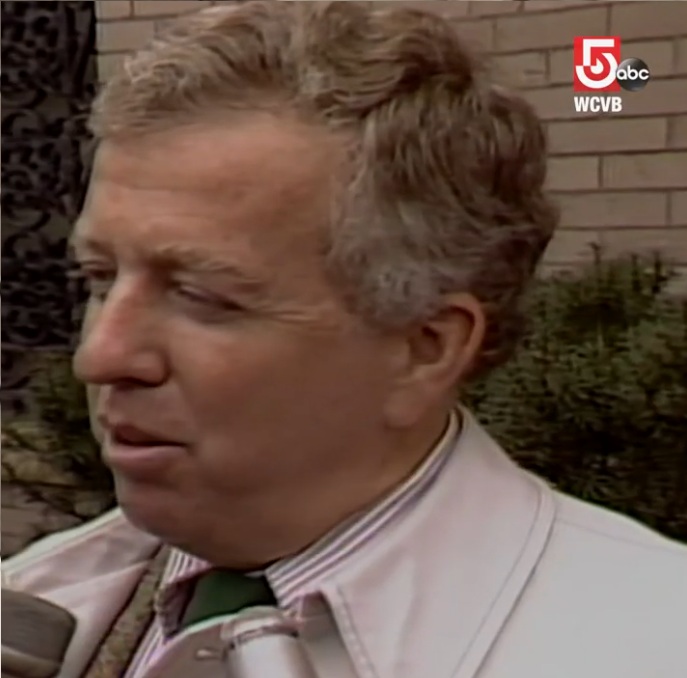 “Ostensibly” that word the Boston Police used the day of the robbery, was not a word or idea conveyed by the FBI 23 years later, at their nationally covered press conference on their progress in the Gardner heist case. In his prepared remarks, at the FBI’s 2013 press conference announcing progress in the case, Richard DesLauriers, the FBI’s Special Agent In Charge of the FBI Boston office said: “Twenty-three years ago today, two men posing as Boston police officers bluffed their way into the museum by telling the night guards they were investigating a disturbance.” So on the day of the robbery the Boston Police had it right and twenty three years later, the FBI had it wrong. The thieves didn’t tell the “night guards they were investigating a disturbance," The guard solely responsible for letting the thieves in, Rick Abath, Geoff Kelly guard now says, was himself, one of the thieves. This press conference two weeks after Rick Abath had done an interview with CNN, which had not yet aired, and which had some details that conflicted with the FBI's narrative. The Boston Police report said: The victim [Rick Abath] states that after gaining entry the suspect told the victim they were responding to a call for the kids outside the museum.
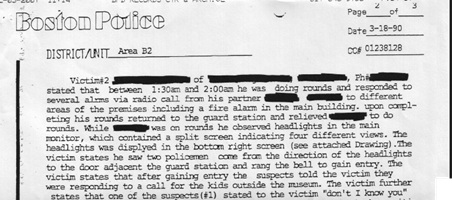 The kids outside had been gone for over seven hours by the time the Boston Police arrived on the scene and questioned Abath. There is no way the Boston Police could have known about the kids outside the museum unless Abath told them that story, and this explanation was not offered until after they were already inside the Museum, Abath told the BPD. Abath changed his story, and the FBI shared Abath's updated version with the public, at a national press conference. Since the first mention of the guards possibly wearing security guard uniforms was made on the day of the robbery by a Boston Police Department spokesperson at a press conference. Someone must have told the Boston Police Spokesperson Captain David Walsh to say that. Furthermore the 2018 WBUR news story referenced by Kelly (which he mischaracterized as something in a nonexistent episode of Last Seen Podcast, did not claim that the police were wearing security guard uniforms. In his book "Master Thieves" Kurkjian wrote that a ransom note writer claimed that “the perpetrators were not dressed as police officers, as reported by the press, but were dressed as security guards.” That ransom note was one that Kelly himself called potentially legitimate 14 years later on an episode American Greed Season 2 Episode 3, "Unsolved: $300 Million Art Heist." It was "extremely well written" and "referred to things in the case not known publicly." Gardner Museum director Anne Hawley said on the program, which first aired on February 13, 2008. Hawley was followed by Geoff Kelly on the program saying of the ransom note: "In 1994 we took it [the ransom note] very seriously and we continue to take it very seriously." Did the ransom note say what Kurkjian reported, that the thieves were wearing security guard uniforms, and if it did, then why did Kelly state on national television 14 years after the museum received the ransom note, that "we continue to take it seriously"? Three years earlier, in 2005, in what CNN's Dan Lothian called "an exclusive on camera appeal from the museum's director, an overture to an anonymous letter writer 11 years ago who seemed legitimate, Anne Hawley said: “I'm particularly interested in hearing from that person who had, I think, a real concern about our getting the work back.” Whether it was a legitimate offer or not became moot because the ransom note writer wanted assurances the FBI would not seek to arrest them during negotiations, a condition the FBI was unwilling to accept, in fact, even though they assured the Gardner Museum that they would. “In an interview at the time, Richard Swensen, the special agent in charge of the office, was adamant that he had ordered the investigators to stand down while the negotiations took place. One agent assigned to the case at the time confirmed he had been directed by superiors not to investigate dealings with the letter writer, but said other investigators had continued to pursue leads on the case,” Kurkjian reported in his WBUR article, Kelly inaccurately referenced in his book. You might think that, moving forward, the best course for the Museum would be to not include the FBI in any future negotiations. But that became impossible four months later when a new federal law, which retired FBI art crime specialist Robert Wittman stated was passed by Congress "because Congress wanted to make the Isabella Stewart Gardner theft a federal crime," made it illegal for the Museum, any museum, to negotiate the return of their own art. The Theft of Major Artwork Act, passed by Congress in September of 1994, and amended in 1996, made it a federal crime not only to steal items of value from a museum or objects of cultural heritage, but that a person “knowing that an object of cultural heritage has been stolen or obtained by fraud, receives, conceals, exhibits, or disposes of the object, shall be fined under this title, imprisoned not more than 10 years, or both.” There is no exception in the law for being, like the Gardner Museum, the crime victim. The Museum is legally obliged, under a federal criminal statute, to include the feds in any recovery effort. There can be no side deals by museums to get their art back under the law. If you have the Gardner art and you call up Robert Fisher or Brian Kelly, or any of the other former DOJ attorneys who worked the Gardner heist case, now defending rich folks in federal court for a living, and you say you have the art, do you think they are going to tell you to call Anthony Amore at the Museum, or the FBI? In 2020, Eric Trickey in Boston Magazine reported that “Once the museum gets the anonymous call or tip it’s been waiting for, there may not be time to wait for a Brinks armored truck to show up at the artworks’ location and shuttle them back home. ‘It’s just as likely I’d have to put them in the back of my Jeep Grand Cherokee and drive them myself,’ [Anthony] Amore says.” Amore's Walter Mitty fantasy, is in actual fact, a federal crime. As much as Amore likes to talk about “our paintings,” which he has never set his eyes on in his life, the way the statute is written, which is supposed to protect Museums collectively from the kind of frequent ransom demands that occur in Europe, it is illegal for a museum to recover its own art, (their paintings) without getting the feds involved. Trickey continues: “If time allows, however, specialists will be brought on-site to package the art—which may be damaged—for transport to the Gardner’s conservation lab. ‘If any flecks of paint are precarious and might flake off,’ Amore says, ‘we’ve got to make sure none of it is lost.’” Yet there were no conservation specialists brought in when the FBI searched for the art in Orlando, covered in Episode Nine of Last Seen Podcast. The FBI excavated a small plot of land, which turned out to be an old septic tank, as any qualified ground penetrating radar technician worth his salt could have told them without a dig. Neither was there anyone from the Gardner Museum present. “The owner reached out to the museum’s security director Anthony Amore to register the tip,” WBUR reported, then the FBI conducted the search, without any participation by the museum. It was likely all for show anyway. You can be sure that Anthony Amore, and Geoff Kelly would have been there in Orlando, Florida on that freezing cold day in February back in Boston if there was the slightest chance any of the art would be recovered. But the message was clear. It is the FBI who recovers art, not museums.
Amore continues to assure journalists, like Bob Ward, Shelley Murphy, and perhaps others, that they will be his first call, if he finds the art.
by Kerry Joyce Copyright © 2026 All Rights Reserved
|